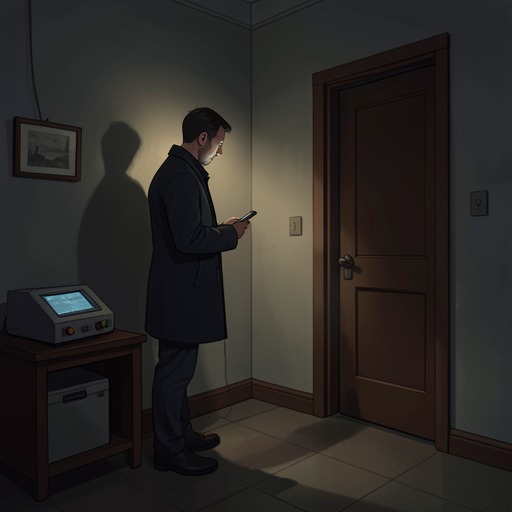
Government meeting audio recordings
Three SecondsGovernment meeting audio recordings are the concealed record through which Ewert Grens confronts senior officials with what was agreed behind closed doors. Their decisive significance lies in the contrast between the assurances preserved on the recording and the official account of the operation: the voices promise protection for Paula, including help with the prison assignment and a future abroad, while also linking that assignment to the Västmannagatan case. Played back in the very room where the meeting occurred, the recordings make private assurances publicly answerable.
The recording brought into the room
Grens introduces the playback through a CD player he says Lars Ågestam gave him nearly five years earlier after a minor altercation. It is a modern model, though Grens admits he had scarcely used it until a couple of weeks before the confrontation, when he began listening to the recordings. The object’s history is personal and unceremonious; its new function is evidentiary. What had sat largely unused becomes the means by which Grens can make an official meeting audible again.
The speakers are a separate part of the setup. Grens says he borrowed them from the property store after a burglary at a flat on Stora Nygatan. The preliminary investigation had been closed, the seized property released, and nobody had claimed the speakers. He places the small units on the table, takes time to connect them, and adjusts their position as the playback proceeds. His careful handling gives the scene a practical, almost procedural rhythm: equipment is assembled, the correct control is found, and recorded voices are directed toward the people being confronted.
Grens presses a button and first identifies the sound as a meeting held in that room, at that table, on May 10 at 15:49. He fast-forwards to a passage marked twenty-eight minutes and twenty-four seconds, then later to another point marked twenty-two minutes and seventeen seconds. The recording is not presented as a general recollection or second-hand report. Grens supplies a date, a time, a location, and identifiable voices, turning playback into a challenge that the listeners can hear for themselves.
What the voices establish
At the first passage, Grens draws attention to the speaker and says that the person addressed should recognize the voice. The official is therefore placed in the position of hearing not an anonymous allegation but a voice tied to the meeting and its participants. The recording’s force depends on this recognition as well as on its content: the people in the room must confront both what was said and who said it.
At the later passage, another voice refers to Paula and says that she does not have time for Västmannagatan. The remark connects the undercover operative’s schedule to the Västmannagatan matter. Rather than treating the operation and the case as separate subjects, the audio reveals that they were discussed in relation to one another. Grens directs his attention to the national police commissioner as the words play, while signs of unease appear around the commissioner’s eyes and in his hands. The recording thus changes the atmosphere of the confrontation without requiring Grens to rely on an unsupported interpretation of the speaker’s identity.
A further segment contains a direct assurance that the operative will not be charged for what happened at Västmannagatan 79 and that officials will do their best to help complete the prison operation. The guarantee joins two matters that carry different institutional stakes: possible criminal liability in the murder case and the continuation of an undercover assignment inside prison. Heard together, these promises indicate that protection was not limited to keeping the operative safe; it also encompassed shielding the operation from consequences arising from the Västmannagatan events.
The recording continues with a promise of care after the work is finished. The speaker acknowledges that the operative will then face a death threat and be branded throughout the criminal world, and promises a new life, a new identity, and money to begin again abroad. The speaker’s assurance is framed as an undertaking made in the capacity of a state secretary in the Ministry of Justice. The recorded language therefore preserves more than a plan for completing the assignment: it documents an anticipated danger and a proposed means of removing the operative from it once the work is done.
Evidence and confrontation
Grens does not play the audio as background. He pauses to identify the meeting, marks the relevant points, redirects the speakers toward particular officials, and makes sure that the state secretary hears the promise in full. When he brings the small speakers closer, the action turns the recorded words into an immediate confrontation. The evidence is reproduced within the institution and before people connected to the recorded commitments; the room is at once the site of the earlier meeting and the setting in which its assurances are challenged.
The playback also answers the weakness of relying on a promise remembered by a single participant. The meeting’s date and location, the voices, and the specific commitments are presented as features of a recording that can be replayed. Grens’s method is to let the preserved words carry the allegation, then set out the possible offenses he believes they disclose: failure to report a crime, protection of a criminal, and conspiracy to commit crime. Those accusations are Grens’s stated reading of the material, while the recorded assurances themselves supply the basis he puts before the officials.
Significance
The recordings expose a sharp division between public authority and private arrangement. The promise to secure Paula’s completion of the prison operation and arrange a new identity abroad places senior officials inside the practical consequences of the undercover work, rather than outside it as detached overseers. The assurances concerning Västmannagatan 79 make that involvement especially consequential: the same conversation addresses both the operative’s potential exposure to prosecution and the state’s continued reliance on the operation.
Their narrative importance also comes from the way they change the status of the meeting. At first it belongs to the past, held behind closed doors and inaccessible to those now being challenged. Through Grens’s playback, its voices return to the same table, where gestures and reactions accompany the words. The object is therefore both a record of an earlier decision and an instrument in a later confrontation. It cannot by itself settle every question of responsibility, but it makes the assurances—and the official authority invoked to give them—difficult to dismiss as mere rumor.